Prospective discovery of LasB inhibitors by integrating generative design, free energy ranking, and experimental validation
Abstract
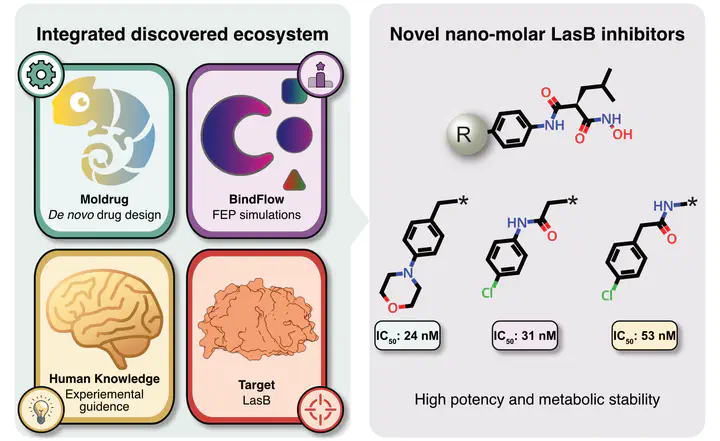
Identifying synthetically accessible, potent ligands from vast chemical space remains a major challenge in drug discovery, particularly because experimental synthesis and testing are costly and low throughput. Here, we present a fully open-source computational–experimental workflow that integrates fragment-based de novo molecular design with rigorous alchemical absolute binding free-energy calculations to enable physics-based prioritization before chemical synthesis. We apply this strategy by targeting the virulence-associated zinc metalloprotease LasB from Pseudomonas aeruginosa. From ~40,000 diverse compounds generated through multi-objective optimization, a small subset was prioritized and experimentally evaluated, leading to the discovery of three previously unreported nanomolar inhibitors (IC50 22–53 nM) with excellent metabolic and plasma stability. This work demonstrates a general and scalable framework for coupling generative molecular design with quantitative binding affinity prediction, improving decision-making and reducing the cost, time, and risk associated with early-stage drug discovery..

Alejandro Martínez León
PhD student